



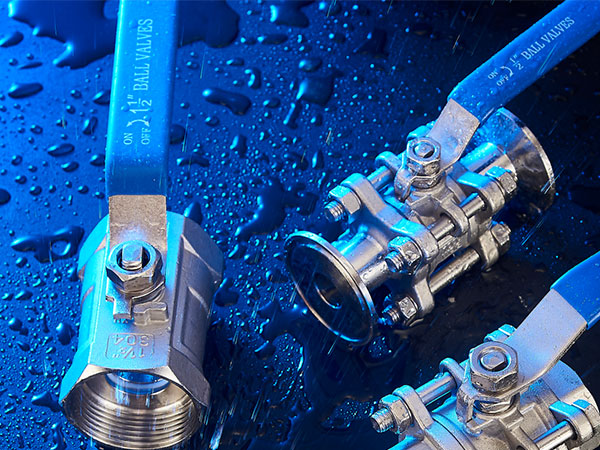
Valves are usually connected to pipes in various ways such as threaded, flanged, welded, clamped, and ferrule wafer. So, how should one choose when using and selecting them?
What are the connection methods between valves and pipes?
1. Threaded connection: Threaded connection is a form where the ends of the valve are processed into internal or external threads to connect with the pipe. Usually, ball valves under 4 inches and stop valves, gate valves, and check valves under 2 inches often use threaded connections. Threaded connections have a relatively simple structure, are lightweight, and are convenient for installation, disassembly, maintenance, and replacement. However, due to the influence of environmental and medium temperatures during use, the valve may expand. To ensure good sealing performance, the expansion coefficients of the two materials at the connection end should be fully considered. Threaded connections may have relatively large leakage channels, so sealing agents, sealing tapes, or packing can be used to block these channels and enhance sealing performance. If the materials of the process and the valve body are weldable, sealing can be performed after threaded connection, and the sealing performance will be better.
2. Flanged connection: Flanged connection is the most common connection method for valves. It is convenient for installation and disassembly, and the flanged connection has reliable sealing. It is more common in high-pressure and large-diameter valves. However, the flanged end is heavy, and the cost is relatively high. Moreover, when the temperature exceeds 350℃, due to the creep and relaxation of bolts, gaskets, and flanges, the load of the bolts will be significantly reduced, and leakage may occur in flanged connections under high stress. Therefore, it is not suitable for use.
3. Welded connection: Welded connections usually have two structural forms: socket welding and butt welding. Generally, socket welding is used for low-pressure valves. Socket welding valves have a simple processing structure and are relatively convenient for welding installation. Butt welding is used for high-pressure valves, but it has a higher cost. The processing difficulty is greater as the pipe standard requires beveling for welding, and the installation process is also more complex. In some processes, radiographic non-destructive testing of the connection weld is also required. When the temperature exceeds 350℃, due to the creep and relaxation of bolts, gaskets, and flanges, the load of the bolts will be significantly reduced, and leakage may occur in flanged connections under high stress.
4. Clamped connection: The clamped connection structure is similar to the flange, but it is lighter and has a lower cost. It is commonly used in sanitary pipelines and equipment. Sanitary pipelines need to be cleaned, and it is strictly prohibited to have residues that can breed bacteria. Therefore, flanged connections and threaded connections are not suitable. Welded connections are difficult to install and disassemble. Therefore, clamped connections are a common connection method in sanitary pipelines.
Add: No. 175, Lane 250, Fangde Road, Jiading District, Shanghai
Tel: +86-21-51863336
Fax: +86-21-34677003
E-mail: shldv@139.com
Web: Http://m.lisagf.com
Fujian plant site:2233 Maosheng Road, Nan 'an City, Fujian Province
Factory telephone:+86-21-31007333

 Shanghai Public Network Anbei: 31011402004337Sitemap
 Home
Home Products
 Application
 Tel
Tel